
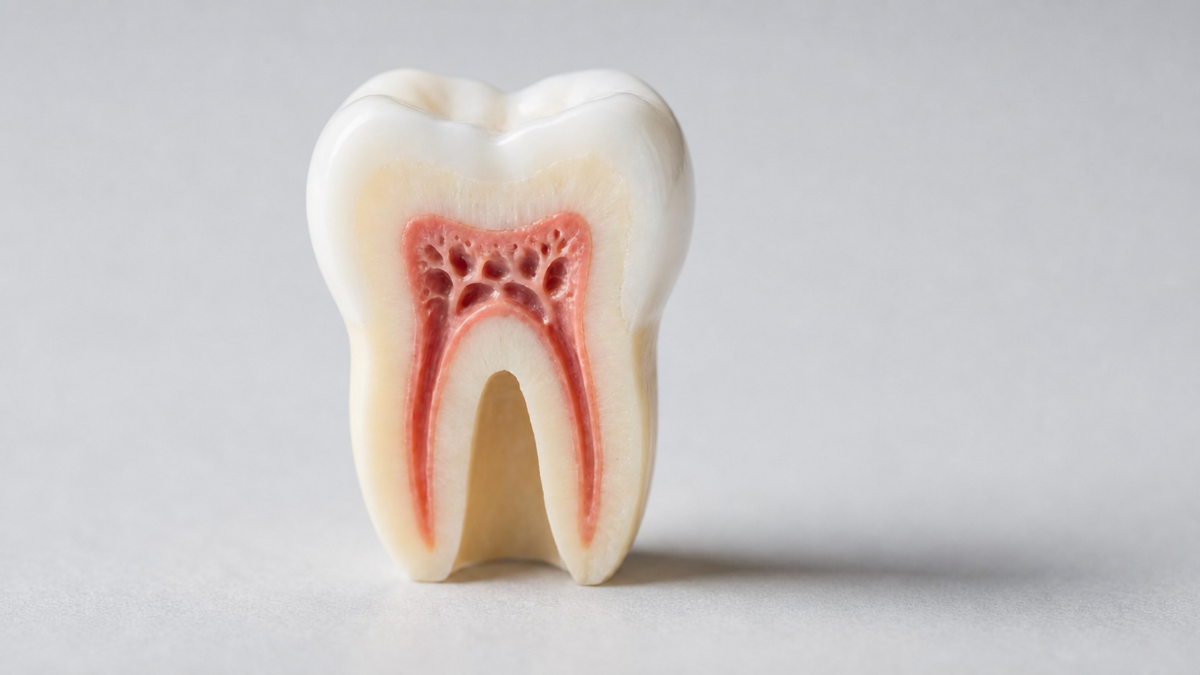
A root canal treats infection inside a tooth by removing the damaged pulp, cleaning the canals within the root, then sealing them. It is recommended when decay or injury reaches the nerve, and it saves a tooth that would otherwise need removing. The area is fully numbed throughout.
What Root Canal Treatment Involves
- Removal of infected or damaged tooth pulp from inside the tooth
- Cleaning and sealing of the canals within the root
- Local numbing used to keep you comfortable
- The procedure explained step by step before treatment begins
- Comfort monitored throughout the visit
- Alternatives discussed where other options exist
How Can You Tell If You Need a Root Canal?
The symptoms are usually hard to ignore, though not always. Worth reporting:
- Persistent tooth pain or sensitivity
- Pain when chewing or biting
- Swelling in the gums or jaw
- Sensitivity to hot or cold that lingers after the source is removed
That last one matters most. Brief sensitivity is common, but discomfort continuing for many seconds after a hot drink suggests the nerve is irritated rather than just sensitive.
Symptoms are confirmed through examination and imaging, because toothache has several causes and not all need this treatment. Some infected teeth cause no pain at all, which is why problems are often found at a routine dental exam first.
What Is Actually Done in a Root Canal?
The tooth is fully numbed first, so what you feel is pressure and movement rather than pain.
- The tooth is numbed and the procedure is explained step by step
- The infected or damaged pulp is removed through a small opening in the tooth
- The canals are cleaned and shaped, clearing the infection out of the root
- The canals are sealed to prevent bacteria re-entering
- The tooth is restored, often with a crown, since a treated tooth is more fragile
Afterwards, expect mild soreness or sensitivity, which usually improves within a few days. Pain management instructions are provided, and most people resume normal activities shortly after. Follow-up care is discussed if needed.

Does a Root Canal Hurt?
Pain is the worry that stops people booking, so it deserves a direct answer: local numbing is used to make sure patient comfort.
What genuinely hurts is the infection beforehand. The reputation belongs to an era before reliable anaesthetic.
Patients searching for a root canal near you are usually in pain already. If anxiety rather than pain is the concern, dental sedation is available.
Root Canal, Filling, or Extraction: What Are the Alternatives?
The choice depends entirely on how deep the damage goes. A filling cannot fix an infected nerve, and an extraction solves the infection by removing the tooth.
| Filling | Root Canal | Extraction | Extraction plus Implant | |
|---|---|---|---|---|
| Appropriate when | Decay has not reached the nerve | Infection has reached the pulp, tooth is restorable | Tooth cannot be saved | Tooth cannot be saved and you want it replaced |
| Keeps your tooth | Yes | Yes | No | No |
| Visits | Usually one | One or more | One | Several over months |
| Afterwards | Nothing further | Often a crown | A gap, or a replacement decision | A fixed replacement |
| CDCP | Covered | Covered | Not covered |
Keeping your own tooth is almost always preferable, and the long-term value compared with extraction is explained before you decide. Where a tooth genuinely cannot be saved, tooth extraction and replacement with a dental implant are discussed openly.
Can a General Dentist Do a Root Canal?
Yes, routinely.
Complexity decides it: the number of canals, unusual root anatomy, a previously treated tooth, or a molar with difficult access. Front teeth are the most straightforward with a single canal, while molars have several.
Do You Need a Crown After a Root Canal?
Often, yes, particularly on back teeth. A treated tooth has had its inner tissue removed, leaving it more fragile and easier to crack under chewing force. A crown covers and protects it.
Front teeth sometimes need only a filling, since they take less force.
How Much Does a Root Canal Cost?
The cost varies based on tooth type and complexity, so it is quoted after assessment. Costs are discussed before treatment begins. Final pricing varies based on your individual clinical needs.
- Which tooth, since molars take longer and have more canals
- Whether a crown is needed afterwards, which is quoted separately
- Insurance coverage is reviewed where it applies
On coverage, the good news: the Canadian Dental Care Plan does cover standard treatment, and standard cases do not need approval in advance. Coverage and any co-payment are reviewed with you in advance.
Frequently Asked Questions
Book Root Canal Treatment in Nobleton
If a tooth is throbbing, sensitive to heat, or painful to bite on, waiting makes it worse. Infection does not resolve on its own, and the sooner it is assessed, the more likely the tooth can be saved.
- Assessment and imaging first, with alternatives explained before anything proceeds
- Fully numbed treatment, sedation available, and costs discussed before beginning
For severe pain or swelling outside a scheduled appointment, emergency dentistry is available. Patients from Nobleton, King City, Bolton, and Schomberg are welcome.
Nobleton Dental Smiles is a dentist in Nobleton, ON, at 12931 Ontario Hwy 27 #3, Nobleton, ON L0G 1N0.