
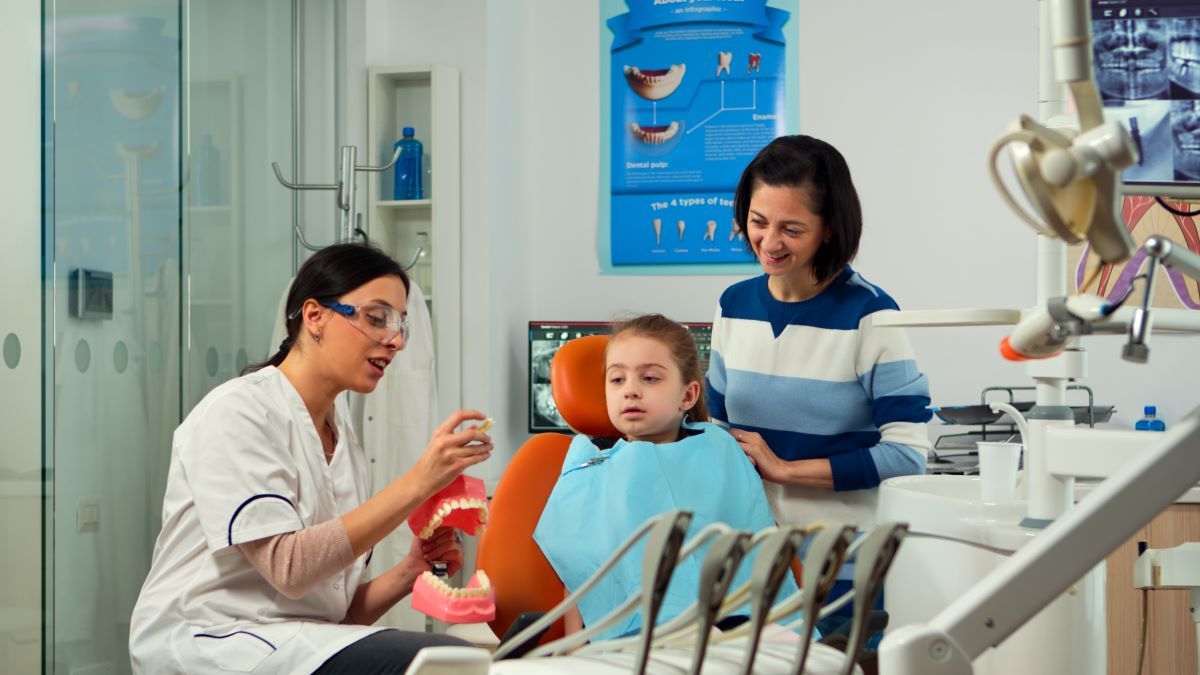
Family dentistry is general dental care provided to every age group within one practice, from a toddler’s first visit through to senior care. It covers routine exams, preventive treatment, and repair work, with one clinical record following each patient as their needs change over the decades.
What Family Dentistry Covers at Every Age
- Children, teens, adults, and seniors treated under one roof, with care matched to each life stage
- Routine exams and checkups alongside preventive care for all ages
- Repair work as needed, so problems are handled where they are found
- Consistent records and history tracking, which is what makes long-term patterns visible
- Flexible scheduling for families, because coordinating several people is the real obstacle
- A gentle approach for children and anxious patients, at every age
What Is Family Dentistry?
Family dentistry is defined by breadth rather than by any single procedure. A family practice does not treat one age group or one type of problem. It looks after a person’s teeth for life, and usually several members of the same household at once.
That means three things in practice: needs are assessed individually, first-time and long-term patients are both accommodated, and treatment adapts as a mouth changes. A nine-year-old, their parent, and their grandparent all need different care. Family dentistry near you should cover all three without sending you elsewhere for ordinary things.
What Care Does a Family Dentist Provide?
The core of family dentistry is routine and preventive, with repair work as required:
- Routine dental exams and checkups, recommended every 6 to 9 months
- Preventive care for all ages, including teeth cleaning, fluoride, and sealants
- Repair work as needed, such as fillings and crowns when decay or damage is found
- Monitoring of oral health changes over time, comparing today against your own history
- Coordination of care across family members, so treatment plans do not collide
How Does Family Dentistry Change at Different Ages?
Family dentistry keeps the same practice but shifts its priorities. What the dentist watches for changes a lot across a lifetime.
| Life Stage | Main Focus | Commonly Involves |
|---|---|---|
| Children | Prevention and building habits | Exams, cleanings, fluoride, sealants, first-visit familiarity |
| Teens | Monitoring change during growth | Bite and alignment checks, wisdom tooth development, hygiene coaching |
| Adults | Keeping things stable and catching problems early | Exams, gum health, repair work, oral cancer screening |
| Seniors | Preserving function and existing work | Gum health, monitoring older restorations, tooth replacement options |
Because care is matched to different life stages, the recall interval and the conversation change with the patient even though the practice does not.
How Does One Clinic Coordinate Care for a Whole Family?
Coordination is the practical advantage of family dentistry, and it is deliberate rather than incidental:
- Individual treatment plans for each patient, not a household template
- Preventive care scheduled alongside other services, reducing separate trips
- Referrals or follow-ups arranged when a concern falls outside routine care
- Next steps explained clearly to parents and caregivers
- Continuity of care across all services, so the dentist treating you knows your history
For a household juggling school and work, the scheduling matters as much as the clinical work. Flexible scheduling for families exists precisely because the appointment nobody can attend is the appointment that gets skipped.
How Does Family Dentistry Protect Long-Term Oral Health?
Prevention and early detection do most of the work. A cavity found at an exam is a filling; the same cavity found two years later may be a root canal or an extraction.
Consistent records are the underrated part. When one practice has tracked your gums for a decade, a small change is visible as a change rather than as a one-off reading. According to the Canadian Dental Association, regular dental visits combined with good home care remain the foundation of preventing both decay and gum disease.
Advice is matched to age and risk, and habits built early tend to stick. That is why family dental care is built around the long term, not just today’s appointment.
What Does Family Dentistry Cost?
Family dentistry cost depends on which services each family member actually needs. Exam pricing varies with what the visit includes, and pricing may differ for children and adults. Final pricing varies based on your individual clinical needs.
- Costs are explained before treatment begins, every time
- Insurance coverage is reviewed where it applies
- CDCP patients are accepted, covering exams, cleanings, X-rays, basic repairs and emergency care subject to approval
- Preventive care comes first because it reduces future treatment need
Frequently Asked Questions
Book Family Dentistry in Nobleton
Moving a whole household to one practice removes a surprising amount of friction: one set of records, one place to call, one relationship to build. Family dentistry works best when it is boring, predictable, and close to home.
- Every age treated in one practice, from first tooth to tooth replacement, with individual plans for each patient
- Flexible scheduling for families, with costs explained before any treatment begins
Families from Nobleton, King City, Bolton, and Schomberg are welcome. Book your family’s visits and keep everyone on the same schedule.
Nobleton Dental Smiles is a dentist in Nobleton, ON, at 12931 Ontario Hwy 27 #3, Nobleton, ON L0G 1N0.