
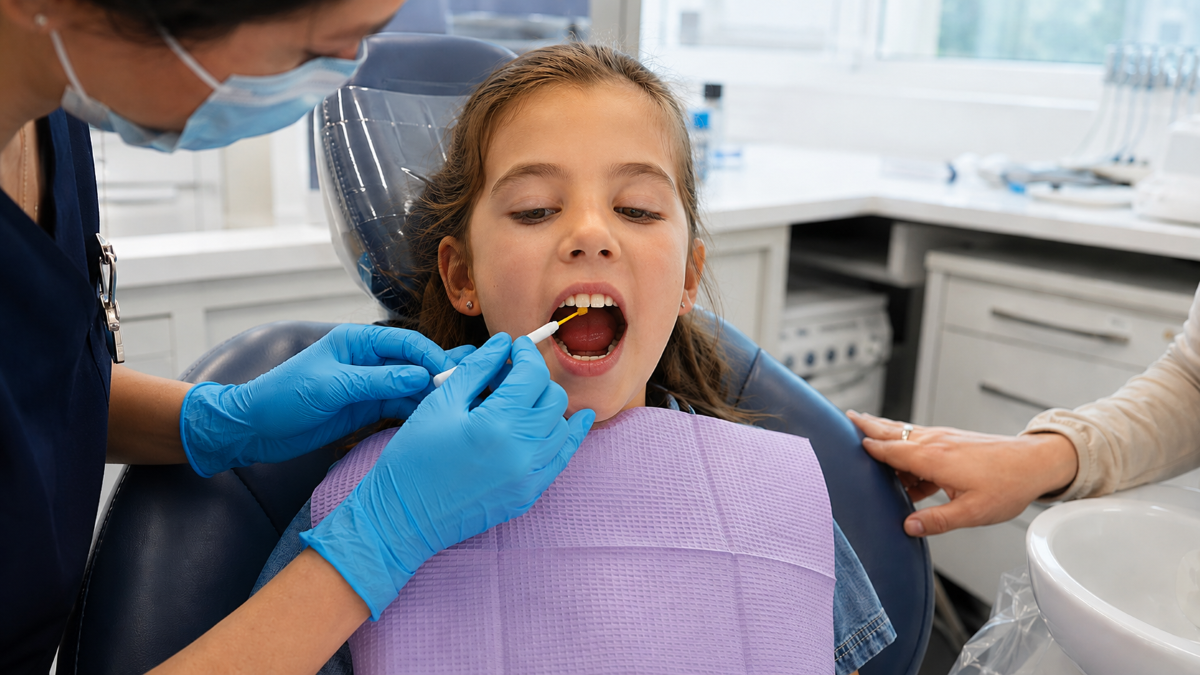
A fluoride treatment is a strong gel, foam, or varnish put on the teeth during a dental visit. It strengthens enamel and lowers the risk of cavities. It works by supporting the natural repair process that reverses early enamel damage before it becomes decay. Application takes minutes and is painless.
What a Fluoride Treatment Involves
- A quick, painless application of gel, foam, or varnish
- Usually completed during a routine visit, with no separate appointment needed
- Strengthens enamel and supports its natural repair
- Recommended based on individual cavity risk, not applied to everyone by default
- Post-treatment instructions provided before you leave
- Minimal disruption to the rest of your day
Is a Fluoride Treatment Good for Your Teeth?
Yes. A fluoride treatment strengthens enamel and lowers the risk of cavities.
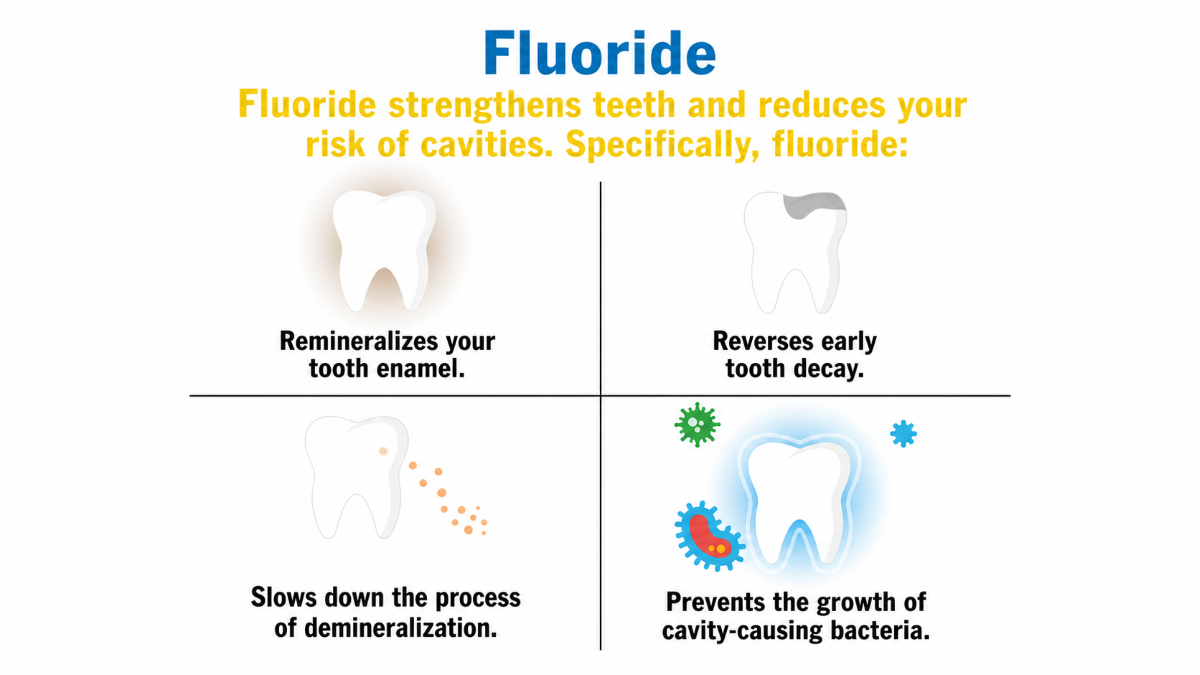
Enamel is constantly losing and regaining minerals. Acid from bacteria and food strips minerals out, and saliva puts them back. Decay begins when the losing outpaces the regaining.
Fluoride shifts that balance. It helps rebuild weakened enamel and makes the rebuilt surface more resistant to acid than it was originally. This is why a fluoride treatment prevents rather than repairs. It strengthens what is already there and can stop early damage, but it cannot fix a cavity that has formed.
According to the Canadian Dental Association, fluoride is one of the most effective measures available for preventing tooth decay.
Who Should Get Fluoride Treatment?
A fluoride treatment is recommended based on an individual cavity risk assessment rather than given to everyone. Those who benefit most:
- Children and teens at higher cavity risk
- Adults who get decay easily
- Patients with enamel weakness or sensitivity
- Patients wearing braces, where brackets make cleaning harder
Patients looking for fluoride treatment near you can usually have it added to a checkup they were already booking.
Risk is not fixed. Diet, medication causing dry mouth, gums shrinking back and exposing the roots, and a history of fillings all raise it. That is why the advice is reviewed each time rather than set once.
For children, this forms part of routine pediatric dentistry alongside cleanings and sealants.
How Is a Fluoride Treatment Applied, and What Happens Afterwards?
The application itself is straightforward. The varnish, gel, or foam is applied directly to the tooth surfaces. There is no drilling, no needle, and nothing uncomfortable.
Afterwards, you will be given post-treatment instructions, which usually means waiting before eating or drinking so the fluoride has time to work. You will be told how long to wait.
- Wait as instructed before eating or drinking
- Everything else continues as normal, since there is no recovery period
In-Office or At-Home Fluoride: What Is the Difference?
Both have a place, and they are not interchangeable. Toothpaste is for daily maintenance; a professional application is a concentrated intervention.
| Professional Application | Toothpaste and Rinses | |
|---|---|---|
| Concentration | High, applied once | Low, applied twice daily |
| Applied by | A clinician, directly to the tooth | You, at home |
| Contact time | Held on the surface, then left to work | Brief, then rinsed away |
| Purpose | Targeted boost for higher-risk teeth | Daily baseline protection |
| Frequency | Usually every 6 months | Twice a day, every day |
Neither replaces the other. Daily fluoride toothpaste is the foundation, and a professional application is added when risk justifies it.
Is a Fluoride Treatment Safe?
Yes, at the doses used in dentistry, and this is worth addressing directly because it is a question people genuinely have.
Professional topical fluoride is applied to the tooth surface in a small quantity by a clinician, then largely removed or absorbed rather than swallowed. That is a very different exposure from ingesting fluoride, which is where most safety concerns originate. The evidence base for topical application in reducing decay is extensive and long-established.
Mild, short-lived effects are possible. The main risk in young children is swallowing too much, which is why it is applied under supervision and the amount is set by age.
If you have concerns, or would rather say no, say so. The advice is based on your cavity risk, and it is a conversation rather than a rule.
How Often Is a Fluoride Treatment Needed, and What Does It Cost?
Usually every 6 months, adjusted based on your cavity risk and reviewed at your dental exam. Higher-risk patients may be advised to have it more frequently.
A fluoride treatment costs $20 to $40. Final pricing varies based on your individual clinical needs.
- Often included with preventive care, or billed separately depending on the visit
- Insurance coverage is reviewed where it applies
- You are informed of cost before application
Set against the cost of a filling, it is among the least expensive preventive measures in dentistry, which is the entire argument for it.
Frequently Asked Questions
Book a Fluoride Treatment in Nobleton
A fluoride treatment is the easiest appointment in dentistry. It is added to a visit you were already making, and the evidence behind it is strong.
- Often paired with dental sealants for back teeth
- Applied during a routine visit, quick and painless, with instructions provided
- Recommended on cavity risk, with cost confirmed before application
Ask about it at your next teeth cleaning or exam. Patients from Nobleton, King City, Bolton, and Schomberg are welcome.
Nobleton Dental Smiles is a dentist in Nobleton, ON, at 12931 Ontario Hwy 27 #3, Nobleton, ON L0G 1N0.