
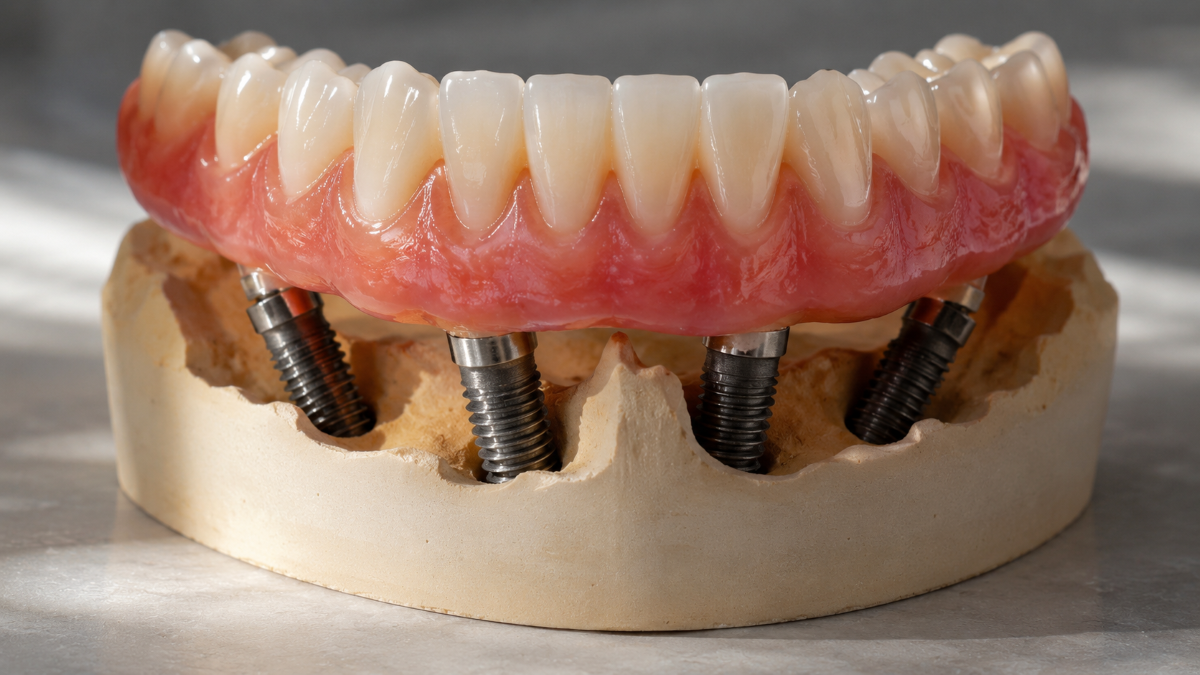
All-on-4 replaces a full upper or lower set of teeth using four implants placed at carefully chosen angles. The teeth are fixed in place, so they do not come out at night. It is designed for people missing most or all of their teeth who want something more stable than a denture.
What All-on-4 Involves
- A full row of teeth supported on four implants
- Fixed, not removable, unlike a conventional denture
- Designed for people missing most or all of their teeth
- Fewer implants than a full set of individual ones needs
- Less bone grafting than a conventional implant plan often requires
- Suitability assessed through imaging and examination
How Does All-on-4 Work?
- Consultation and imaging, to see what the bone will support.
- The implants are placed in surgery.
- Temporary teeth are fitted where that is appropriate.
- Healing, while the bone fuses to the implants.
- The final teeth are fitted once healing is complete.
The healing stage is the part people underestimate. Bone has to grow onto the implants before the final teeth go on.
All-on-4, Dentures, or Individual Implants?
All three replace missing teeth, and the honest differences are what should decide it.
| All-on-4 | Dentures | Individual implants | |
|---|---|---|---|
| Fixed or removable | Fixed | Removable | Fixed |
| Implants needed | Four per arch | None | One per tooth, or several |
| Stability | High | Depends on fit | High |
| Bone grafting | Designed to reduce the need for extensive grafting | Not needed | Assessed case by case |
| Surgery | Yes | No | Yes |
The angle is the clever part. Placing four implants at a tilt lets them reach bone that is still solid. That is how the treatment often sidesteps the grafting a conventional plan would need.
What Is the Downside of All on Four Dental Implants?
All-on-4 is not right for everyone. It suits people missing most or all of their teeth who want stability, and who are prepared for surgery and a healing period. The honest limitations are these:
- It is surgery, with real healing requirements
- It does not suit every patient, and imaging decides that rather than preference
- It needs maintaining over the years
- The teeth on top wear, and may need repair or replacement in time
Those points are discussed openly before treatment rather than after it. Anyone presenting this as a one-and-done solution is overselling it.
How Long Will All on Four Dental Implants Last?
The implants themselves are titanium. They do not decay, and with good bone and good hygiene they can outlast the patient.
What actually decides the outcome:
- Your oral hygiene, which is the single biggest factor
- Your bite, and how much force goes through it
- Your general health habits
- Regular follow-up, which is not optional with this treatment
The distinction worth holding on to: the implants and the teeth on top are different things. The implants are built to last. The teeth attached to them are a wearing part, and they are maintained and replaced like any other restoration.
How Much Do All-on-4 Implants Cost in Canada?
There is no single figure, because the cost moves with complexity and materials.
- Complexity of your case and what the bone requires
- Materials used for the final teeth
- Insurance coverage is reviewed, and it is often limited
- Financing or phased treatment is discussed where it is available
All of that is discussed with you at the assessment, so you see what your own plan involves before you commit.
Frequently Asked Questions
Book an All-on-4 Assessment in Nobleton
People searching for All-on-4 near you are usually weighing it against dentures, and the deciding factor is almost always stability. Whether your bone will support it is a question imaging answers, not a phone call.
- Fixed teeth on four implants, with the limitations explained openly
- Assessed on imaging, with dentures and individual implants compared honestly
Patients from Nobleton, King City, Bolton, and Schomberg are welcome.
Nobleton Dental Smiles is a dentist in Nobleton, ON, at 12931 Ontario Hwy 27 #3, Nobleton, ON L0G 1N0.