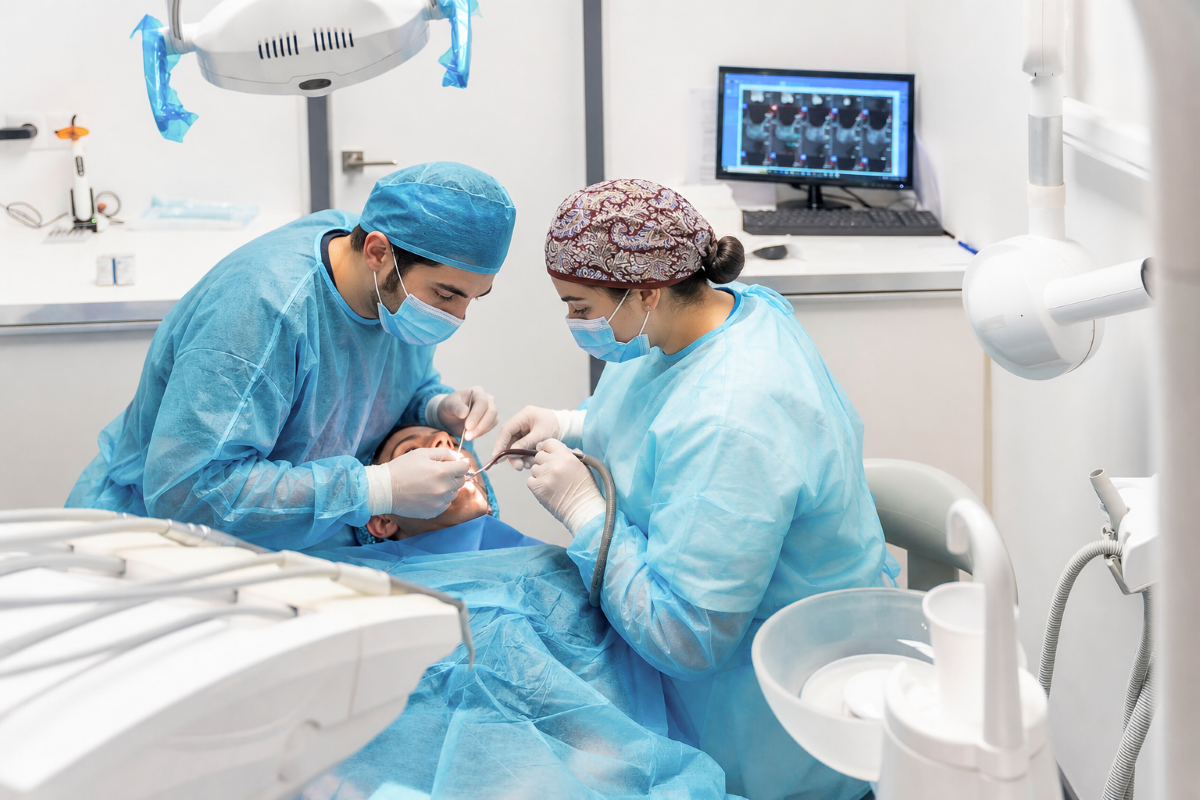
Maxillofacial surgery covers procedures on the jaws, mouth, and face that go beyond routine dental treatment. It includes bone grafting, sinus lifts, complex implant placement, and removing cysts or growths from the jaw. Some cases are treated at the clinic and some are referred on.
What Does Maxillofacial Surgery Include?
- Bone grafting, to rebuild jawbone
- Sinus lifts, where the upper jaw needs more bone height
- Advanced implant placement
- Removal of cysts, tumours, or other growths in the jaw or mouth
- A visiting surgical partner who operates in-house
- Referral to a trusted local centre where a case belongs there
What Is Maxillofacial Surgery?
Maxillofacial surgery is the branch of dentistry that treats the mouth, jaws, and face surgically. In practice it covers anything more involved than a straightforward extraction.
You may also see it written as oral and maxillofacial surgery. It is the same field. “Oral” means the mouth and teeth. “Maxillofacial” means the jaws and face. The two overlap so much that people use the terms to mean the same thing.
The everyday version is well understood. Taking out a difficult wisdom tooth is minor oral surgery. What changes is the complexity of the case.
| Routine oral surgery | Maxillofacial procedures | |
|---|---|---|
| Examples | Extractions, wisdom teeth | Bone grafting, sinus lifts, removing cysts |
| Where | At the practice | In-house with a surgical partner, or referred |
| Anaesthesia | Local numbing, sedation if needed | Local with sedation, or general anaesthesia |
What Is Bone Grafting?
Bone grafting rebuilds jawbone where there is not enough of it left.
Bone shrinks after a tooth is lost, because it is no longer being loaded by a root. Over months and years the ridge gets narrower and shorter. If too much has gone, there is nothing solid for an implant to anchor into.
A graft adds material to the site, and the body slowly replaces it with its own bone. That takes time, which is why grafting is a separate stage rather than something done on the same day as an implant.
What Is a Sinus Lift?
A sinus lift is a specific kind of graft, used in the upper back jaw.
The sinus cavities sit directly above the upper back teeth, and there is often very little bone between them. When an upper molar has been missing a while, the sinus floor can drop further still.
A sinus lift raises that floor and places graft material underneath, creating the height an implant needs.
Who Does Maxillofacial Surgery?
Who performs your surgery is worth asking anywhere, and the answer here has two parts.
Some cases are performed at the clinic by a visiting surgical partner who operates in-house.
Some cases are referred out. Where a case belongs at a dedicated maxillofacial centre, you are assessed here and referred to a trusted local one. Being told a case is better handled elsewhere is not a brush-off. It is what you want a practice to do.
Worth knowing in general. In Ontario, only a dentist registered as a specialist with the Royal College of Dental Surgeons of Ontario may advertise as one. You are entitled to ask any practice who will perform your surgery and what their registration is.
How Is Comfort Managed During Maxillofacial Surgery?
Two approaches are available:
- Local anaesthesia with oral conscious sedation
- General anaesthesia options
Which is appropriate depends on the procedure and on your medical history, and it is worth raising early rather than on the day.
Who Pays for Maxillofacial Surgery, Medical or Dental Insurance?
Maxillofacial procedures can fall on either side, and sometimes both. That is not a technicality, because it changes which policy the claim goes to.
The treatment coordinators handle all approvals and appeals. That means the claim is submitted and argued on your behalf rather than left to you.
When Do You Need Maxillofacial Surgery?
People searching for maxillofacial surgery near you usually arrive by one of three routes:
- An implant plan stalls. There is not enough bone, and implants cannot be placed until it is rebuilt with a graft or a sinus lift.
- Something shows up on an X-ray. A cyst or growth in the jaw is often found at a routine dental exam with no symptoms at all.
- A tooth is too complex to remove normally, usually because of its position or its roots.
The Canadian Dental Association recommends regular examinations, and this is one of the reasons why. A cyst in the jaw commonly causes no symptoms until it is large.
Frequently Asked Questions
Book a Maxillofacial Surgery Assessment in Nobleton
If an implant plan has stalled on bone, or something has shown up on an X-ray, a surgical assessment is the place to start.
- Bone grafting, sinus lifts, advanced implants, and removal of cysts or growths
- Treated in-house with a visiting surgical partner, or referred to a trusted local centre
Patients from Nobleton, King City, Bolton, and Schomberg are welcome.
Nobleton Dental Smiles is a dentist in Nobleton, ON, at 12931 Ontario Hwy 27 #3, Nobleton, ON L0G 1N0.