
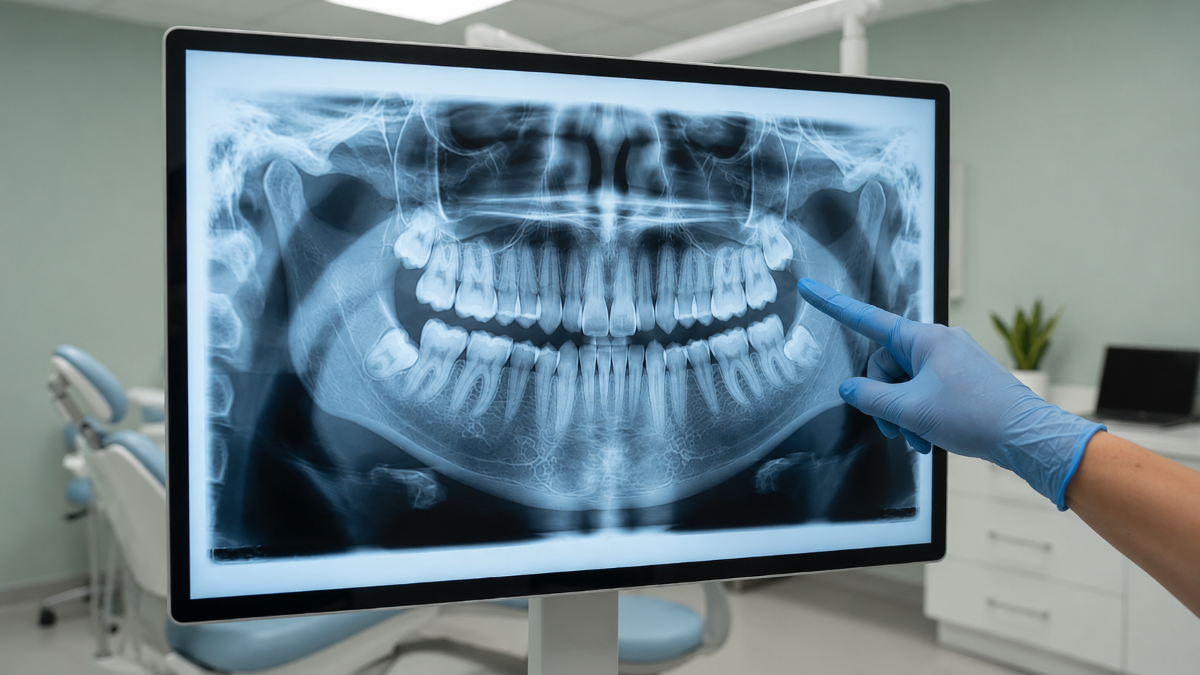
Wisdom teeth removal is the extraction of one or more third molars. These are the last teeth to develop, usually appearing in the late teens or early twenties. It is recommended when a tooth is impacted, badly angled, decayed, or damaging its neighbour. The decision follows clinical examination and imaging rather than age alone.
What Wisdom Teeth Removal Involves
- Assessment of tooth position, alignment, and available space in the jaw
- Examination and imaging to establish what is actually happening below the gumline
- Local numbing, with sedation options discussed where appropriate
- The procedure explained clearly before any treatment begins
- A recovery timeline explained in advance, including swelling and healing
- Post-operative care instructions provided, and costs explained before treatment
What Are Wisdom Teeth and When Do They Appear?
Wisdom teeth are the third molars at the very back of the mouth, the last adult teeth to develop. Most emerge in the late teens or early adulthood, though timing varies a lot.
Their development is checked during routine dental exams, often for years before anything needs deciding. Watching a tooth’s angle and the space around it over time tells the dentist far more than a single snapshot.
What Are the Signs Wisdom Teeth Are Causing Problems?
Trouble usually announces itself at the back of the jaw. The signs worth reporting are:
- Jaw pain or pressure at the back of the mouth
- Swelling or tenderness in the gums around the area
- Difficulty opening your mouth fully
- Headaches or ear-related discomfort on the affected side
Any of these is assessed through examination and imaging, not symptoms alone. What you feel and what is happening to the tooth are not always the same.
Do Wisdom Teeth Always Need to Be Removed?
No, and this is worth saying plainly because the assumption runs the other way. Removal is recommended when there is a reason for it, not as a routine milestone. The judgement rests on position, space, and harm.
| Removal usually advised | Monitoring usually appropriate | |
|---|---|---|
| Position | Stuck, angled, or pressing on the tooth in front | Come through upright and normally |
| Space | Not enough room to come through | Enough space, fully through the gum |
| Health of the tooth | Decay, or gum infection around a partly erupted tooth | Clean, healthy, and reachable with a toothbrush |
| Effect on other teeth | Damaging the tooth in front | No effect on nearby teeth |
| Symptoms | Recurring pain, swelling, or infection | No symptoms, stable over time |
| Review | Timing discussed based on risk and age | Reassessed at routine exams |
A tooth that is straightforward to remove at twenty can be much more involved at fifty.
Can a General Dentist Remove Wisdom Teeth?
Frequently, yes. Wisdom teeth removal is classified as oral surgery. Cases are assessed individually, and referral is arranged where one is needed.
What determines it is the individual tooth: how it sits, how deep it is, its relationship to the nerve and sinus, and your medical history.
Straightforward tooth extraction cases are routine general practice work. Complex cases are referred to a maxillofacial centre, and being told a referral is appropriate is a sign of good judgement rather than a limitation.
Patients looking for wisdom teeth removal near you are usually best served by starting with an assessment rather than assuming a specialist is required.
What Happens During and After Wisdom Teeth Removal?
Wisdom teeth removal is explained in full before anything begins, including what to expect afterwards.
- Local numbing or sedation options are discussed where appropriate, including dental sedation for anxious patients or longer appointments.
- The tooth is removed.
- Post-operative instructions are provided covering eating, cleaning, and activity.
- The recovery timeline is explained, including the swelling that normally follows.
Your recovery timeline is explained to you in advance, including what to expect from swelling and healing. How long it takes depends on the teeth and how complex the case is.
How Much Does Wisdom Teeth Removal Cost?
Wisdom teeth removal usually costs $150 to $699 per tooth. Final pricing varies based on your individual clinical needs.
What moves the figure within that range:
- Tooth position and complexity. A fully erupted tooth is straightforward; a deeply impacted one is surgery, and the price reflects the difference.
- Surgical factors. Whether the tooth needs sectioning, and how much bone is involved.
- Sedation. Choosing sedation affects the total, and that is discussed with you beforehand.
- How many teeth. Pricing is per tooth, so removing four costs more than removing one.
Insurance coverage is reviewed where it applies, and costs are explained before treatment begins. CDCP patients are accepted, with select major procedures covered subject to approval.
Frequently Asked Questions
Book Wisdom Teeth Removal in Nobleton
If a wisdom tooth is aching, swelling, or making it hard to open your jaw, an assessment settles the question. Imaging shows what is happening below the gumline, and you get a clear answer on whether the tooth needs to go.
- Assessment first, covering position, space, and effect on neighbouring teeth, with the reasoning explained
- Costs explained before treatment begins, with sedation options discussed where appropriate
According to the Canadian Dental Association, third molars should be assessed individually rather than removed as a matter of routine. Patients from Nobleton, King City, Bolton, and Schomberg are welcome.
Nobleton Dental Smiles is a dentist in Nobleton, ON, at 12931 Ontario Hwy 27 #3, Nobleton, ON L0G 1N0.