
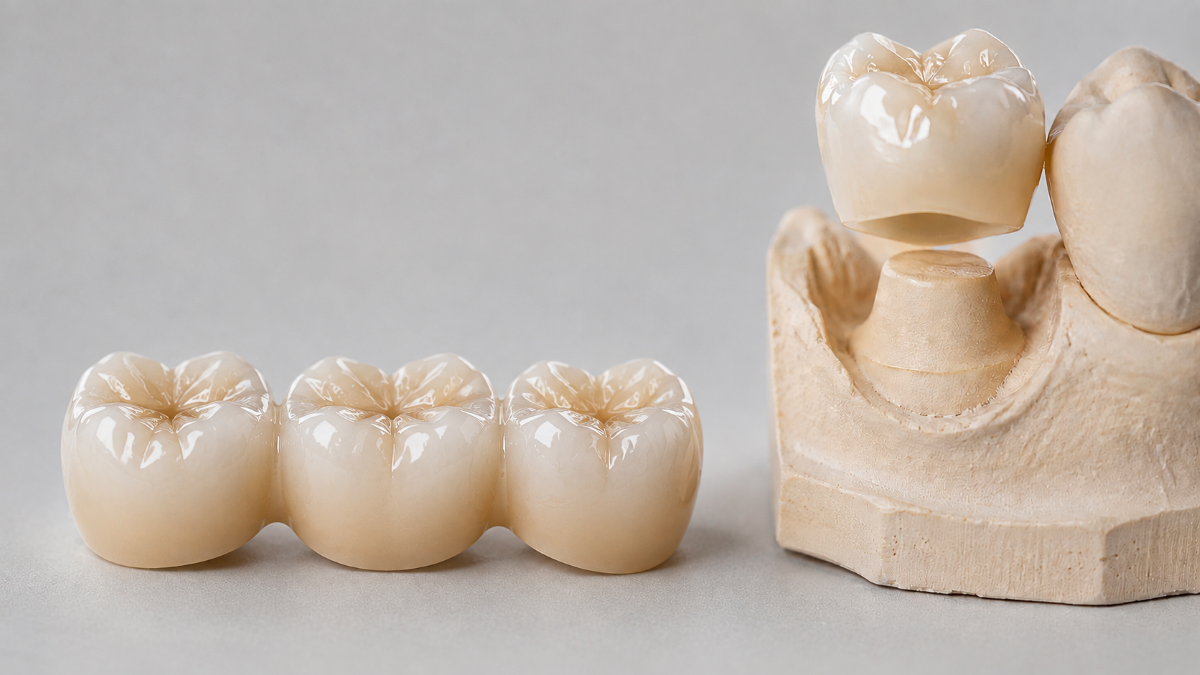
A dental crown is a custom-made covering fitted over a damaged or weakened tooth to restore its shape and strength. A bridge replaces one or more missing teeth by fixing a replacement to the teeth either side of the gap. Both are fixed restorations, cemented in place rather than removable.
What Dental Crowns and Bridges Do
- Crowns restore and protect damaged or weakened teeth
- Bridges replace one or more missing teeth
- Crowns are often recommended after a large filling or root canal treatment
- Bridges are used when the teeth either side can hold a replacement
- The advice follows an examination, not a default
- Costs are explained before treatment begins
What Is a Dental Crown?
A dental crown fits over the whole visible part of a tooth, restoring its shape, strength, and appearance. Patients sometimes call it a cap, and the two words describe the same thing.
Crowns are recommended when a tooth has too little solid tooth left to hold a filling properly. That usually follows one of three things: a very large filling, a fracture, or root canal therapy. A treated tooth is more fragile and can split under chewing force.
Patients searching for a dental crown near you should expect an assessment first. Whether a crown is the right answer depends on how much tooth is left.
What Is a Dental Bridge, and What Types Are There?
A dental bridge fills a gap. A false tooth sits in the space. It is held by crowns fitted onto the natural teeth either side, which are shaped first.
| Type of bridge | How it works | Usually suits |
|---|---|---|
| Traditional | Crowns on the teeth either side hold the replacement | A gap with healthy teeth either side |
| Cantilever | Held from one side only | A gap with a healthy tooth on just one side |
| Maryland | Bonded with thin wings behind the teeth either side | Front teeth, where saving enamel matters |
| Implant-supported | Fixed to dental implants rather than natural teeth | Larger gaps, or where the teeth either side are healthy and best left alone |
The traditional design is the most common. A Maryland bridge saves far more of the teeth either side, which matters when those are undamaged.
Crown, Bridge, or Implant: Which Do You Need?
The first question is whether the tooth still exists. Crowns save a tooth; bridges and implants replace one.
| Crown | Bridge | Implant | |
|---|---|---|---|
| The tooth is | Damaged but still present | Missing | Missing |
| Teeth either side | Untouched | Shaped and crowned | Untouched |
| Surgery | No | No | Yes |
| Treatment time | Weeks | Weeks | Months |
| Preserves jawbone | Yes, the root remains | No | Yes |
| Relative cost | Middle | Middle | Highest |
Crowns are recommended to preserve natural teeth wherever possible. Where a tooth is already missing, a dental bridge is discussed when implants are not chosen, and the decision weighs bone health, cost, and longevity.
An onlay covers only part of the tooth rather than all of it. It is sometimes an option instead of a full dental crown, where more of the natural tooth is still sound.
Can You Get a Same-Day Dental Crown?
Same-day crowns are listed among the services offered here. Whether one suits your tooth is confirmed at the assessment.
The term describes a crown completed in a single appointment rather than over two, which is the conventional route. Whether one suits your tooth is a clinical decision, and the advice follows an examination.
Patients looking for same day dental crowns near you should ask when booking, so it can be confirmed for your case beforehand.
How Long Do Dental Crowns and Bridges Last?
Longevity depends on the material used, your bite forces, and how well the restoration is cared for. There is no fixed lifespan, and any clinic quoting one is guessing.
- Material matters. Different materials handle chewing force differently, and the choice is discussed for your specific tooth.
- Bite forces matter more than most people expect. Grinding or clenching shortens the life of any restoration.
- Cleaning around a bridge is the weak point. The area beneath the false tooth collects plaque and needs cleaning on purpose.
Crowns and bridges are checked at regular visits, and replacement is discussed when wear or damage appears rather than left until something fails.
How Much Do Dental Crowns and Bridges Cost, and Does CDCP Cover Them?
Dental crowns range from $2,200 to $2,500. Final pricing varies based on your individual clinical needs.
Bridge pricing depends on the number of units, meaning how many teeth the bridge covers. A three-unit bridge, replacing one tooth with a crown either side, costs less than a four or five-unit bridge. Cost also varies with material, tooth location, and complexity.
On coverage: crowns and bridges may be covered by the Canadian Dental Care Plan where they are medically necessary rather than cosmetic. They must be approved before treatment starts.
That matters practically: a crown cannot be claimed retroactively, so approval must be arranged first. Insurance coverage is reviewed with you, and the long-term value compared with alternatives is explained.
Frequently Asked Questions
Book a Dental Crown or Bridge Consultation in Nobleton
Whether you need a dental crown, a bridge, or something simpler comes down to how much tooth is left. That takes an examination, not a phone call.
- Assessment first, with crowns, bridges, and implants compared openly before anything is decided
- Costs explained before treatment begins, including any CDCP approval needed
A dental exam is the starting point. Patients from Nobleton, King City, Bolton, and Schomberg are welcome.
Nobleton Dental Smiles is a dentist in Nobleton, ON, at 12931 Ontario Hwy 27 #3, Nobleton, ON L0G 1N0.